Horse management software: the complete guide for owners

Anyone who owns a horse knows the truth: the hard part isn't riding — it's keeping everything else in order. Vaccine dates, the last farrier visit, the vet's X-rays, the insurance policy, hay receipts, the microchip number. Horse management software exists for exactly this: turning scattered notes, farrier text threads and drawers full of paperwork into one tidy record you carry in your pocket. This guide explains what horse management software really is, which features matter, how to pick the right one, and why Hippolife is built for the private owner rather than the large stable.
What is horse management software?
Horse management software is an app — web or mobile — that gathers everything about a horse's care, health and daily management in one place. It's not just a calendar: it's a digital health record combined with a document vault, a reminder system and an expense log.
Historically these tools were built for stables and riding centres: box management, client billing, staff rotas, studbooks. They're powerful, but designed for a business — not for someone with one or two horses who simply wants to remember when the next deworming is due or find last year's radiograph in three seconds. For years the private owner had only two options: bend a complex barn-management system to their needs, or improvise with phone notes, photos and reminders.
A good modern platform fills exactly that gap: the depth of a professional health record with the simplicity of an app you open one-handed at the barn.
Why private owners need software (not a stable-management system)
Caring for a horse produces a surprising amount of data. International veterinary guidance — such as that of the American Association of Equine Practitioners and the British Equine Veterinary Association — recommends a precise schedule of vaccinations, dental checks, deworming and routine exams. Missing one isn't just an oversight; it can have health consequences and, in competition, lead to disqualification.
Then there's the paperwork. In Europe every equine must be identified and travel with an official identification document (the passport), under the European Union's equine identification rules. Certificates, sale contracts, policies and lab results pile up — and without a vault, the day a vet or buyer asks for them, the PDF hunt through months-old emails begins.
Stable-management software solves a business's problems; the private owner needs something different: one place, always with them, where each horse has its complete story. That's the difference between enterprise software and a tool built for the person who loves and looks after their horse.
The features good horse management software must have
Not all tools are equal. Before choosing one, check that it truly covers the areas that matter in real life. Here are the essentials:
A complete health record — every event (exam, vaccine, colic, wound, treatment) logged with date, cost, notes and photo or PDF attachments. Smart recurring reminders — farriery, vaccines, dentist, deworming, insurance: reminders that reschedule themselves once you log the task as done. Digital passport and document vault — identity, microchip, certificates, X-rays and policies always at hand and shareable. A health index — a clear, explainable snapshot of the horse's status. An expense log — what your horse really costs, month by month and by category. A daily diary — mood, appetite, water, training, weight. Multi-horse and team support — if you have several horses or work with a groom and trainer.
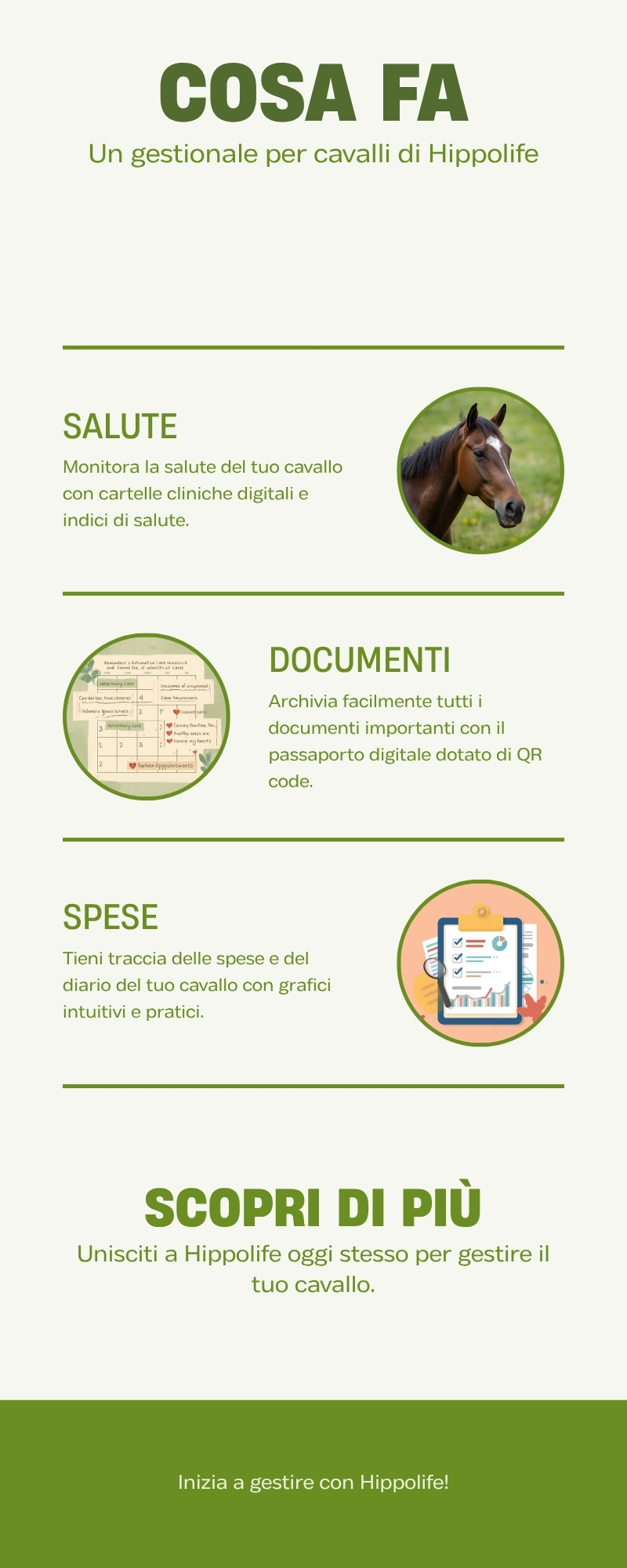
The infographic below sums up how Hippolife covers these areas in one mobile-first interface.
Digital health record and a 0–100 Health Index
The heart of horse management software is the digital health record. In Hippolife every horse has a health timeline with more than a dozen event types: from vaccination to colic, from therapy to a simple dressing. Each entry can include the cost, free notes and attachments — so the X-ray your vet emailed doesn't get lost, but stays tied to the day and event it belongs to.
On top of this data, Hippolife computes a Health Index from 0 to 100 that is deterministic and explainable: not a magic number from an opaque algorithm, but a score you can understand and check, paired with a visual status (🟢🟠🔴). At a glance it tells you whether there are overdue tasks, missed checks or signals worth watching — the kind of summary that helps non-vets keep sight of the bigger picture. Over weeks and months, that same record becomes a genuine clinical history: the next time you change vet, move yards or take the horse to a clinic, the full timeline travels with you instead of living in someone else's filing cabinet. For accessible, reliable material on continuous health monitoring, specialist publications such as The Horse are a trustworthy reference.
Reminders that reschedule themselves
The feature owners love most is also the easiest to explain: reminders that never let you down. Farriery every 6–8 weeks, annual vaccine boosters, seasonal deworming, dental checks, insurance renewal. In well-built software you set the recurrence once; when you mark the task done, the next due date reschedules automatically.
This removes the most common mistake: doing the right thing but forgetting to move the date forward, ending up with a calendar full of stale, overdue reminders. Leading veterinary guidelines — like those published by equine veterinary associations — stress that regularity is what truly protects a horse's health: vaccinating once isn't enough, the cycle has to be respected. Good software turns those recommendations into a routine that manages itself.
A digital passport and document vault always with you
In Europe a horse travels with its official paper passport, mandatory for identification and movement under the European Union's equine identification rules. But the paper booklet can be left at home, gets damaged, and doesn't hold everything you need in the moment.
Software adds a digital passport: identity, microchip number, vaccination history and key documents always on your phone, shareable in seconds with a vet, buyer or competition secretary via link or QR code — and revocable whenever you want. Alongside it, a document vault organised by category and with expiry dates keeps certificates, radiographs, policies and contracts, so nothing is lost and no renewal slips through.
This is Hippolife's distinctive trait: the only platform that gives a private owner a complete digital passport together with a full document vault. We've written a whole guide on it: read Digital horse passport & document vault. Note: the digital passport is a working copy you always carry, not a legal substitute for the official paper one.
Expenses, diary and working with your team
A horse is also a financial commitment, and underestimating it is one of the most frequent mistakes newcomers make. Software with an expense log shows you — with monthly charts and category breakdowns — what your horse really costs: livery, farriery, vet, feed, supplements, transport. Having those numbers under control helps you plan and avoid unpleasant surprises.
The daily diary adds the everyday-wellbeing dimension: mood, appetite, water intake, training done, weight, photos. Read over time, this data reveals changes the eye alone would miss. Finally, many horses are cared for by more than one person — owner, groom, trainer. Collaboration and sharing features let you assign tasks, share reminders and keep everyone aligned, without endless message threads.
Software, a spreadsheet or phone notes: what really changes
Many owners start with what they already have: a spreadsheet, phone notes, a folder of photos. It works… until it doesn't. A spreadsheet won't warn you when a vaccine is due, won't attach the X-ray to the right event, and won't open comfortably one-handed while you hold the lead rope. Phone notes multiply and get lost; photos of reports drown in a gallery of thousands of shots.
The difference isn't how much information you manage to save — it's the ability to find it again and be reminded at the right moment. Software links every piece of data to a horse, a date and a category, and turns deadlines into active reminders. When the vet asks for the vaccination history, or a buyer wants to see the radiographs, the difference between five seconds and half an hour of searching is exactly there. A spreadsheet is still great for sums; the real life of a horse needs a tool that unites data, documents and reminders in one flow. It's the jump from "jotting down" to "managing".
Common horse-care mistakes (and how an app prevents them)
Anyone who looks after horses knows the recurring slip-ups. Forgetting a booster vaccine because the year flew by: software reschedules the due date itself and warns you in advance. Losing a document just when you need it: a category-based vault keeps it at hand. Underestimating costs: without an expense log it's easy to discover too late how heavy the monthly total is. Missing a gradual change in appetite or weight: the daily diary makes slow trends visible. Relying on the memory of several people caring for the same horse, with information lost in messages: sharing features keep everyone aligned.
No app replaces an expert eye and your vet, but good software removes the "silly" mistakes — the ones caused not by a lack of skill but by the lack of a system. It's the safety net that frees up more time and energy for the good part: being with the horse.
How to choose the right software: 7 concrete criteria
Faced with several options, judge each tool against these seven criteria:
1. Is it built for your profile? A private owner doesn't need billing and box management — look for an owner-first tool. 2. Does it work well on a phone? Most of the work happens at the barn, standing, one-handed: the app must be mobile-first. 3. Does it handle documents and attachments? Photos and PDFs of reports and X-rays must be easy to upload and find. 4. Do reminders reschedule themselves? That's the difference between a tool you keep and one you drop after a month. 5. Is your data yours and exportable? Look for the ability to export everything (for example as JSON), so you're never locked in. 6. Is the pricing honest? A real free plan to start and a transparent premium. 7. Is it multilingual and shareable? Useful if you work with professionals or sell abroad.
Hippolife was built around these answers: mobile-first, installable as a PWA, with full data export, available in English, Italian and Spanish.
What it costs and how to start in 5 minutes
Hippolife's model is designed to keep the barrier to entry as low as possible: one horse is free forever, with health record, reminders, passport and documents included. The Premium plan (€4.99/month) unlocks unlimited horses and team features. No credit card to try it.
Getting started takes minutes: sign up free, create your horse's profile (name, breed, microchip, photo), set the first reminders — farriery, vaccines, deworming — and upload the documents you already have on your phone. From then on the app works for you: it warns you before deadlines, keeps the health history tidy, and finds any document in three seconds. Because Hippolife installs as a Progressive Web App, it sits on your home screen like a native app and works even in a barn with patchy signal. You can start today, with a single horse, and see within a week whether software really changes the way you care for them — then add more horses whenever you're ready.
FAQ
- What's the difference between horse management software and stable-management software?
- Stable-management software serves a business: boxes, clients, billing, rotas. Software for the private owner like Hippolife focuses on the individual horse — health record, reminders, passport, documents and expenses — with the simplicity of an app you use at the barn.
- Do I need to be tech-savvy to use it?
- No. Hippolife is mobile-first and designed for one-handed daily use: you log an event or upload a document in a few taps. Demo mode lets you try it instantly, with no commitment.
- Does the software replace the vet or the official passport?
- No. It's an organisational tool: it gathers and orders information, but it doesn't replace your vet's judgement or the official paper passport required by law. The digital passport is a working copy you always carry.
- Can I manage more than one horse?
- Yes. The Free plan covers one horse; Premium (€4.99/month) unlocks unlimited horses, each with its own health record, reminders, passport and document vault.
- Is my data safe and can I export it?
- Yes. Hippolife lets you export all your data (as JSON): your horse's history stays yours and you're never locked into the platform.
- Is there an app like Hippolife built for the private owner?
- Hippolife is the only platform that combines a complete digital passport and document vault for the individual owner, rather than for large stables or federations. That's exactly the market gap it fills.
Sources
- Fédération Équestre Internationale (FEI) — The international federation for equestrian sport: health and identification rules.
- American Association of Equine Practitioners (AAEP) — Veterinary guidelines on vaccination and routine horse care.
- British Equine Veterinary Association (BEVA) — The UK association of equine vets: clinical best practice.
- European Union — Equine identification (Reg. EU 2021/963) — European rules on the equine passport and identification.
- The Horse — A trusted specialist publication on equine health and care.