Horse care schedule: vaccines, farriery, deworming and dental checks
A horse's health isn't decided by one dramatic event, but by the sum of many small, regular routines spread across the year. Vaccines, farriery, deworming, dental checks and periodic exams each follow their own rhythm: some things are due every six weeks, others every six months, others once a year. It's this mix of different frequencies that makes everything so hard to keep in your head. This guide walks through the typical frequency of each treatment, a practical month-by-month example, and how to turn that schedule into reminders that never let you down — with Hippolife, built for the private owner.
Why your horse needs a care schedule
A horse's health is built on continuity, not on isolated episodes. The leading equine veterinary bodies — such as the American Association of Equine Practitioners and the British Equine Veterinary Association — agree on one point: what truly protects a horse isn't any single treatment, but the regularity with which it is repeated over time. A late vaccine, a skipped farrier visit or a forgotten deworming opens small gaps that, added up, chip away at wellbeing and — for those who compete — at the validity of health paperwork.
The difficulty is that every task has a different frequency, and the dates overlap: six weeks for the farrier, a year for the dentist, variable intervals for vaccines and deworming. Keeping it all in mind is nearly impossible, and that's where things slip.
A care schedule exists for exactly this: to put in writing what to do and when, so no due date depends on memory. It doesn't add work — it reduces it, because it takes the job of remembering out of your head and hands it to a system.
Vaccinations: the most common ones and how often
Vaccinations are the first item on any schedule. The protocols vary by country, the horse's age, its environment and its activity (especially if it competes), but some principles are shared. Veterinary guidelines distinguish between core vaccines, recommended for almost every horse, and risk-based vaccines, chosen with your vet according to exposure.
Among the most common: tetanus, usually with periodic boosters (often every 1–2 years after the initial course, plus an extra booster in case of a wound); equine influenza, frequently required by competition rules — the Fédération Équestre Internationale mandates boosters at set intervals for competing horses; equine herpesvirus (EHV); and, in certain regions, rabies, West Nile or other endemic diseases.
The practical rule: there is no universal vaccination calendar. Your vet defines the right protocol for your horse and your area; your job is to keep the boosters on time and never let cover lapse, above all if you compete, because a late booster can mean exclusion from an event.
Farriery and trimming: the 6–8 week rhythm
The hoof grows continuously, a bit like a human nail. That's why foot care is one of the most frequent tasks of all: most horses need the farrier roughly every 6–8 weeks, whether for shoeing or a simple trim for barefoot horses. The exact interval depends on growth rate, terrain, season and workload.
Putting it off too long isn't a cosmetic detail: an overgrown or unbalanced hoof alters the limb's alignment and can encourage lameness and joint problems. The old saying «no hoof, no horse» sums up centuries of practical experience.
It's also the most frequently recurring due date, and therefore the easiest to lose track of in the daily grind. Recording the last date and the next, with a reminder that moves forward each time, is the simplest way to keep a steady rhythm. Noting the type of shoeing and attaching a photo of the hoof also helps you and your farrier follow how it changes over time.
Deworming: from a fixed calendar to fecal egg counts
For decades deworming followed a fixed calendar: a wormer every few months, the same for every horse. Veterinary medicine has since changed its approach. Because of growing parasite resistance to drugs, bodies such as the AAEP recommend a targeted programme based on fecal egg counts (FEC): you measure the individual horse's actual parasite burden and treat only when needed, with the right active ingredient.
In practice this means alternating, across the year, a number of egg counts with targeted treatments — often concentrated in specific seasons and tailored to the individual animal, since foals and young horses follow different schemes from adults. The goal is twofold: protect the horse and avoid burning through the drugs' effectiveness with unnecessary treatments.
Here too the watchword is personalisation: your vet sets the plan based on test results, pasture management and region. Your schedule, as a result, won't say «a deworming every so often» but rather a sequence of planned tests and treatments — worth recording so you never lose track of what was given and when.
Dental care: the horse's teeth
A horse's teeth grow throughout its life and wear down with chewing. Uneven wear creates sharp points and edges that cut the cheeks and tongue, make chewing painful and can impair feeding and bit acceptance during work. That's why a periodic check and, when needed, dental floating are part of the routine.
The typical frequency is at least once a year for most adult horses, but it can be more frequent in young or senior animals or those with known issues — always following the advice of your vet or equine dental technician. Signs such as dropping feed from the mouth, weight loss, bad breath, balls of unchewed hay or unexplained resistance to the bit can mean it's time for a check, even before the annual due date.
It's a task that easily slips down the priority list, precisely because horses instinctively hide pain. Putting it in the schedule at a fixed cadence stops the year from «flying by» and keeps a problem from being discovered only once it's already advanced.
Routine exams and seasonal checks
Beyond the scheduled treatments, a good calendar includes moments of general review. Many owners pair the vet's visit with vaccine boosters, combining prophylaxis and an overall exam in a single appointment: body condition score, coat, eyes, heart, breathing, limb alignment.
Some checks are seasonal. Spring and autumn change feeding, coat and pasture management; summer brings flies, sun and heat stress; winter brings the rug, water that freezes and reduced movement. Noting a seasonal reminder — «spring check», «getting ready for winter» — helps you stay ahead.
Finally there are checks tied to specific events: the pre-purchase exam when buying a horse, the tests required before certain competitions or international travel, or simply a focused check when something feels off. None of these replaces daily observation, but together they form the net that keeps health under control over time.
Paperwork deadlines: passport, insurance and competition documents
A care schedule isn't only syringes and shoes: there's also the paperwork side, with its own deadlines. In Europe every horse must be identified and travel with its official passport, under the European Union's equine identification rules. The booklet must be kept up to date and available.
On top of this come the insurance policy with its annual renewal, any health certificates for transport, and the health requirements for competitions: many federations require vaccinations — influenza in particular — to be recorded and on time, on pain of exclusion. Losing sight of one of these dates can cost you a place at an event or leave you uncovered exactly when it matters.
That's why it pays to keep care and documents together, in the same place. A digital passport and a document vault with expiry dates — like those described in our guide Digital horse passport & document vault — turn «invisible» deadlines into active reminders, and let you find any certificate in seconds when a vet or competition secretary asks for it.
A sample horse care calendar, month by month
How does all of this translate into a concrete year? Here's an indicative example — always to be adapted with your vet and to your area:
Every 6–8 weeks: farrier (shoeing or trim). Every month: weight and body condition check, review of medicine and supplement stocks. Spring: general exam plus any vaccine boosters, fecal egg count and targeted deworming, a gradual move to pasture. Summer: fly and heat management, hydration checks. Autumn: second fecal egg count or treatment if indicated, annual dental check, coat and rug preparation. Winter: attention to freezing water, movement and feeding, plus a check of documents expiring at year end. Once a year: dental check, insurance renewal, a full review of the vaccination picture.
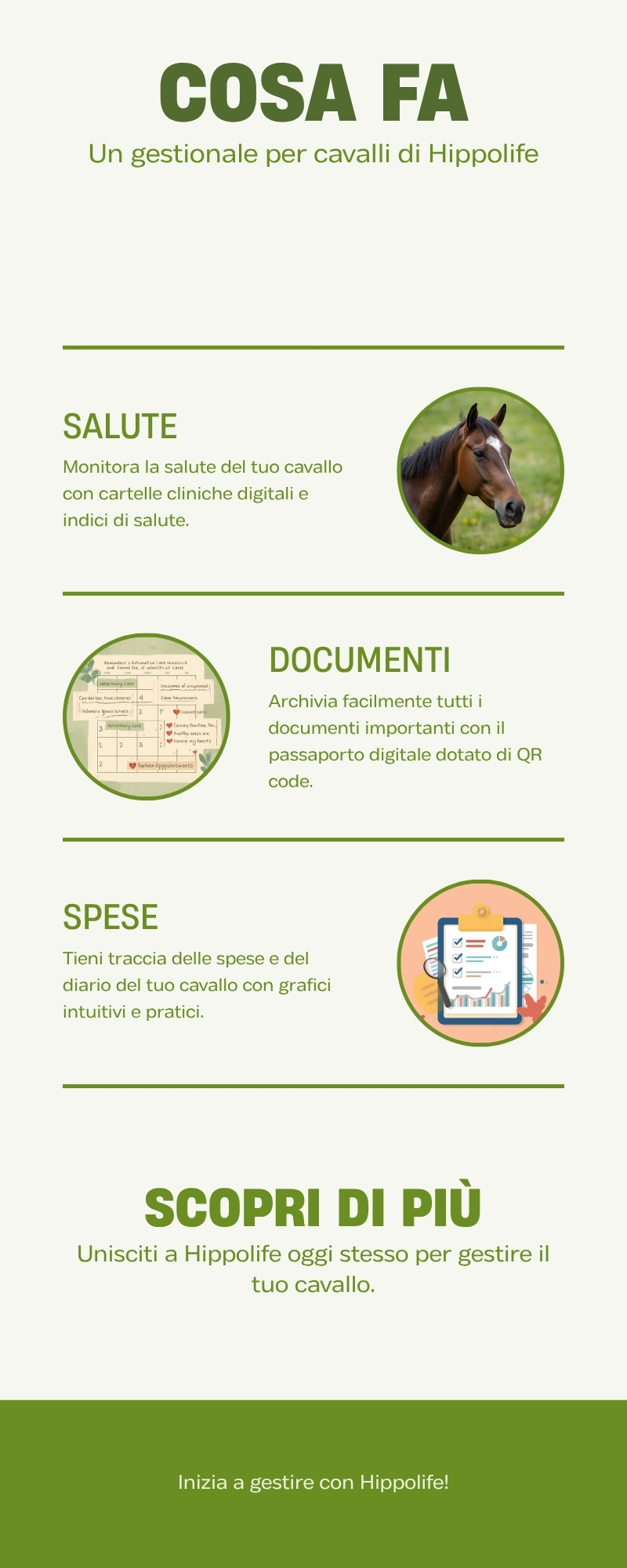
The infographic below shows how Hippolife gathers these areas — health, documents and expenses — in one mobile interface. A schedule like this isn't about doing everything alone; it's about forgetting nothing and arriving at every appointment with your horse's history already in order.
Why regularity matters more than any single treatment
One idea runs through every item on this schedule: consistency beats intensity. A horse vaccinated precisely every year is better protected than one vaccinated «whenever we remember»; a hoof maintained every six weeks is healthier than one left to grow and then corrected in a hurry; a tooth checked in time avoids the problem that, neglected, becomes serious.
It's a principle well documented in veterinary publishing — magazines like The Horse return to it often: regular preventive care costs less, in money and in stress, than the emergencies it prevents. The trouble is that regularity is hard to maintain by hand, precisely because each task has a different frequency and the dates pile up.
This is the real value of a well-kept schedule: it doesn't add work, it reduces it, by taking the job of remembering out of your head. It turns dozens of scattered deadlines into an orderly flow, where each task automatically produces the next. It's the difference between chasing deadlines and letting them manage themselves.
How to never miss a due date again
The weak point of any paper or mental calendar is always the same: you did the right thing but forgot to move the date forward. You shoe the horse but don't reschedule the next appointment; you vaccinate but lose track of when cover expires. After a few months the calendar is full of stale, overdue items, and you stop trusting it.
The answer is a system of reminders that reschedule themselves. In software like Hippolife you set the recurrence once — farriery every 6–8 weeks, an annual vaccine booster, a dental check — and when you log the task as done, the next due date is created automatically. Each treatment stays linked to its history, with cost, notes and attachments, building the horse's health record.
It's the same engine described in our guide Horse management software: the complete guide: a calendar that not only reminds you what to do, but keeps track of everything you've already done. So the information no longer lives in one person's memory, but in an orderly archive you always carry in your pocket.
How to build your schedule in 5 minutes
You don't need a complicated system to begin: a few minutes and the information you already have are enough. The simplest way is to start with an app built for the private owner. Sign up free, create your horse's profile (name, breed, microchip, photo) and enter the last known dates: the last farrier visit, the last vaccine, the last dental check.
From there you set the main recurrences and let the app warn you before each due date. You upload the documents you already have on your phone — passport, certificates, reports — so the health picture and the paperwork finally live in the same place. With Hippolife one horse is free forever, with health record, reminders, passport and documents included; the Premium plan (€4.99/month) adds unlimited horses and team features.
The result isn't «one more app» but one less worry: the care schedule stops being a weight on your memory and becomes a routine that runs almost by itself. Remember, though: a schedule organises and reminds, but it doesn't replace your vet, who remains the reference point for every health decision.
FAQ
- How often should a horse be vaccinated?
- It depends on the vaccine, the region and the horse's activity. In general, core vaccines like tetanus have periodic boosters (often every 1–2 years after the initial course), while equine influenza required for competition has more frequent boosters at intervals set by the rules. Your vet defines the exact protocol.
- How often does a horse need shoeing?
- Most horses need the farrier roughly every 6–8 weeks, whether for shoeing or trimming barefoot horses. The interval depends on hoof growth, terrain, season and workload.
- How often should a horse be dewormed?
- There's no longer a single fixed calendar for all horses. Current guidelines recommend a targeted approach based on fecal egg counts, treating only when needed to counter parasite resistance. The plan should be agreed with your vet.
- How often should a horse's teeth be checked?
- Usually at least once a year for adults, and more often for young or senior horses or those with known issues. Signs like weight loss, dropping feed from the mouth or resistance to the bit may call for an earlier check.
- Is the care schedule the same for every horse?
- No. Age, activity, region, pasture management and health status all change the frequencies and priorities. This guide offers typical reference intervals, but the schedule should always be personalised with your vet.
- How do I keep track of all these due dates?
- The simplest way is an app with reminders that reschedule themselves, like Hippolife: you set the recurrence once and, each time a task is logged as done, the next due date is created automatically, staying linked to the horse's health record.
Sources
- American Association of Equine Practitioners (AAEP) — Guidelines on vaccination and targeted deworming (fecal egg counts) for horses.
- British Equine Veterinary Association (BEVA) — The UK association of equine vets: clinical and preventive best practice.
- Fédération Équestre Internationale (FEI) — Health and vaccination rules for horses competing internationally.
- European Union — Equine identification (Reg. EU 2021/963) — European legislation on equine passports and identification.
- The Horse — A specialist publication on horse health and care.