Horse apps: which ones exist and how to pick the right one

Search for horse apps and the problem shows up immediately: the same label covers tools that do completely different jobs. There is the app that records your ride over GPS, the one that reminds you about the vaccine booster, the platform that invoices livery clients, and the federation app that only matters if you compete. Downloading the wrong one is why most people are back to a notebook two weeks later.
This guide sorts it out. We will look at the four families of horse apps that actually exist, what each does, what it costs and — above all — which one fits you: one or two horses, probably kept at a livery yard, and a simple wish to never forget anything.
Key takeaways
- «Horse app» is not one category: there are four families — riding trackers, owner management apps, stable software, and federation apps that are mandatory at competitions.
- Trackers such as Equilab measure work in the saddle — distance, speed, gaits, route — and include a horse calendar; they are not built as a health record with attachments, documents and a shareable passport.
- A private owner needs five things: a health record with attachments, recurring due dates that reschedule themselves, a document vault, a digital passport shareable by QR code, and an expense log.
- Prices checked in September 2026: Equilab Premium €12.99 a month or €99.99 a year; Hippolife free forever with one horse, Premium €4.99 a month or €49.99 a year.
- As of 1 July 2026, presenting a horse at an FEI event without influenza vaccination details registered in the FEI HorseApp is sanctioned; riders who do not compete at that level do not need the app.
- The most effective setup is not to choose: a tracker for training and a management app for health, documents and due dates answer two different questions.
«Horse app» is not one category: the four families
Before comparing names, it helps to see that the market splits into four families with different goals.
1. Riding and tracking apps. They measure work in the saddle: distance, speed, gaits, GPS route, sometimes the horse's symmetry. They serve the rider who wants to see progress. 2. Owner-first horse management apps. They keep the horse's story: health record, farrier and vaccination due dates, documents, expenses, digital passport. They serve the owner. 3. Stable management software. Stalls, clients, staff shifts, invoicing: business software, not personal software. 4. Federation apps. Like the FEI HorseApp: mandatory if you compete internationally, not needed if you don't.
So the right question is not «which is the best horse app» but «what job do I want the app to do». A tracker will never remind you about worming; a health record will never tell you how many kilometres you trotted. Different trades.
Riding trackers: what they do (and what they don't)
This is the best known family, the one that usually shows up first when you search for a riding app. The best known is Equilab, built by the Swedish company Equestrian Insights AB: it records distance, speed, gaits and turns using your phone or Apple Watch, adds gait analysis, goals and challenges, a community chat, and a Safety Tracking feature that shares your live location with a safety contact and raises the alarm if you stop moving. On the Italian App Store it is free with in-app purchases: Premium at €12.99 per month, €59.99 for six months or €99.99 per year (prices checked in September 2026), rated 4.8 out of 5.
It is a good product at what it does: measuring work in the saddle, and its official site also lists a horse calendar and sharing with selected contacts, so it is not merely a stopwatch.
What a tracking app is not, by design, is a health record: typed health events (check-up, vaccination, colic, treatment) with cost and attachments, photos and PDFs of reports and X-rays, a document vault, passport and microchip data, recurring due dates that reschedule themselves when you mark a job done, a public passport shareable by QR code, an expense log. That is not a flaw — it is the edge of the product, and every product has one.
In practice: if your problem is «how much did I trot today», a tracker is plenty. If your problem is «when is the vaccine due and where are the X-rays», you need a different family — and neither replaces the other.
Owner management apps: health, due dates, documents
This is the family that solves the daily problems of the person who owns the horse, not only rides it. An app like this has to cover five things, and each is worth checking before you commit.
A complete health record — every health event (check-up, vaccination, colic, wound, treatment) with date, cost, notes and photo or PDF attachments, in chronological order. Recurring due dates that reschedule themselves — you set «shoeing every 6 weeks» once and, when you mark the job done, the next due date creates itself. A document vault — passport, microchip, insurance, reports, X-rays, all searchable and available at the yard. A shareable digital passport — a link or QR code for the vet, the farrier or a buyer, with nothing to install on their side. Expenses — because a horse is also a budget.
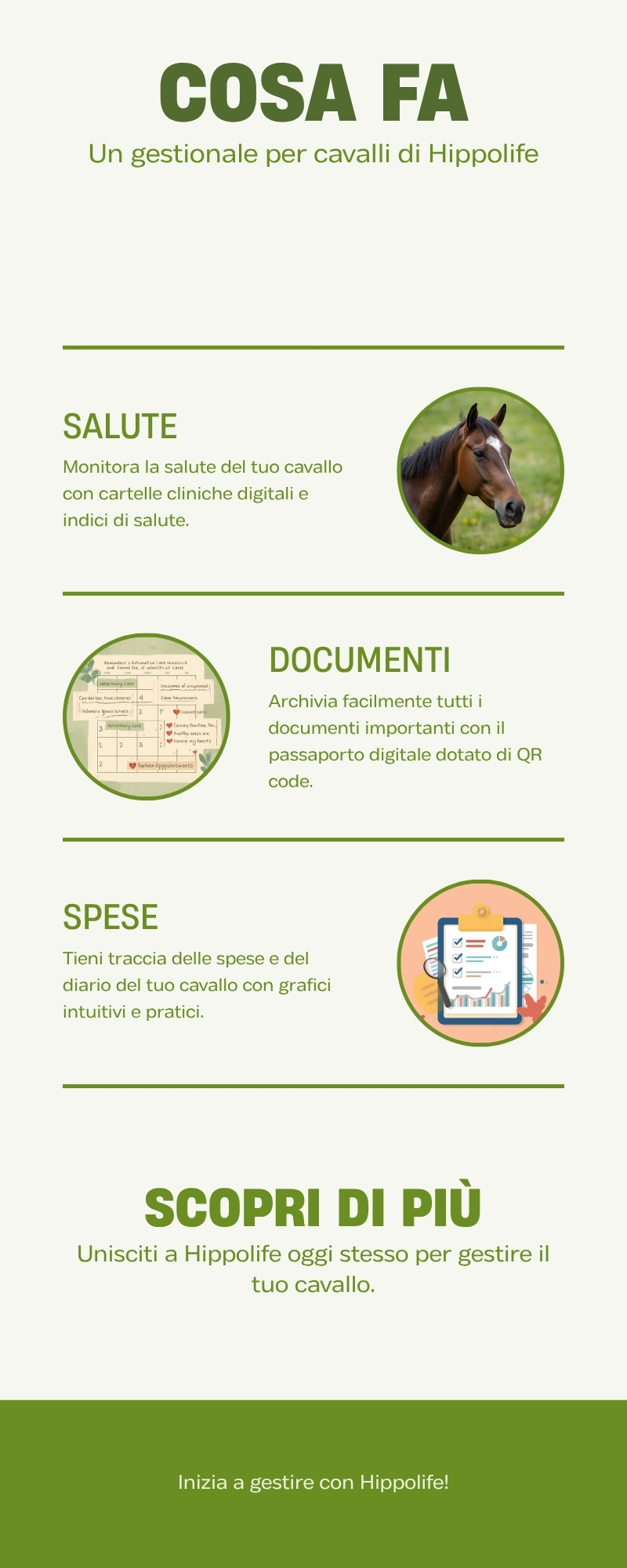
Hippolife is built on exactly those five things, plus a 0–100 Health Index that condenses into one number how up to date a horse is: due dates respected, recent events, documents on file. It runs from your phone, installs from the home screen as well as from the App Store, and is designed for the yard: few taps, one hand, weak signal. For the full picture of this category, see our guide on horse management software.
Stable management software: powerful, but not for you
The third family is stable software: stall assignment, client records, staff shifts, lessons, livery invoicing. These are business tools, licensed per yard or per horse, and they make perfect sense for someone running an equestrian centre.
For a private owner they are the wrong choice twice over: they cost like B2B services and they make you navigate features you will never use — nobody invoices themselves for livery. The warning sign is simple: if the first screen asks how many stalls you have, that software was not written for you.
Watch out for the opposite mistake too: generic pet apps. They are fine for a dog or a cat, but they know nothing about microchips and UELN codes, shoeing cycles, colic or faecal-egg-count based worming. Vocabulary matters more than it seems — an app that does not know what farriery is will never remind you to book it.
The FEI HorseApp: mandatory, but only if you compete
Then there is the federation family, and in 2026 it became news. Since 3 February 2025 the FEI has paired the paper passport with digital registration of equine influenza vaccinations for registered horses: the vet records the vaccination in real time in the FEI HorseApp after identifying the horse by microchip or passport barcode. As the Italian federation FISE points out, vaccinations can no longer be registered retroactively, and horses vaccinated less than 7 days before a competition starts are refused by the app and cannot enter the venue. The FEI has enforced the rule strictly since 1 January 2026 and, as of 1 July 2026, the person responsible for a horse presented at an event without correctly registered vaccination details is fined under Article 1002 and Annex VI of the FEI Veterinary Regulations.
Two practical consequences. First: if you compete at FEI level the app is not optional, but it remains a competition tool — it concerns FEI-registered horses and checks at events, not your day-to-day management. Second, and more interesting: the direction of travel is clear. A horse's health dates are moving from paper to digital, and owners who already keep their own record in order — photos of the vaccination pages, dates, vaccine batch numbers — reach those deadlines without a scramble. That holds even if you never compete: a digital passport and document vault is the working copy you always carry.
What horse apps cost
Prices follow the families. Tracking apps are free at the basic level and charge a subscription for the advanced features: for Equilab, €12.99 a month or €99.99 a year (Italian App Store, September 2026). Stable software is priced per yard or per horse and easily reaches tens of euros a month. Federation apps are not bought at all: they come with your registration.
Owner apps sit at the other end, because their value is in daily use rather than professional features. Hippolife is free forever with one horse — health record, due dates, digital passport, documents, diary and expenses included, no credit card and no trial that quietly expires — and Premium costs €4.99 a month or €49.99 a year for unlimited horses and sharing features (Premium comes with a 14-day trial; the free plan never expires).
When you compare prices, look past the headline figure: is the free plan really free or a 14-day trial? Do you pay per horse, so the bill grows with the yard? And above all: can you export your data if you change your mind? An app that holds your horse's history hostage is expensive at any price.
How to choose: 7 questions to ask before installing
1. What problem am I solving? Progress in the saddle, or due dates and documents: the answer picks the family, not the brand. 2. Is it made for a private owner? If it talks about stalls, clients and invoices, it is business software. 3. Does it speak equestrian? Microchip and UELN, farriery, worming, colic, dental check: a generic pet app will not get there. 4. Do due dates reschedule themselves? That is the difference between an app you keep and one you drop after a month. 5. Does it handle real attachments? Photos and PDFs of reports and X-rays must go in and come back out in three seconds. 6. Does it work at the yard? Mobile-first, fast, usable one-handed on a weak signal. 7. Is your data yours and exportable? Look for a full export: your horse's history has to be able to leave.
Answer those seven honestly and you are usually left with one or two options — often from different families. If you are weighing specific names such as MyHorse, EquiStab or EquiTrack, we put them side by side in our horse management app comparison.
Can you use them together? Yes, and that is the best setup
Asking «Equilab or Hippolife?» is like asking «running watch or medical record?». They answer two different questions about the same horse.
The combination that works for most owners is simple: a tracking app for work in the saddle, when you want to measure training; a management app like Hippolife for everything that happens outside the saddle — vaccinations, shoeing, vet visits, documents, costs, a passport you can show. You open the first one when you ride; the second one works even when you don't open it, because it warns you before things fall due.
If you really had to pick one, look at what happens when things go wrong: on the night the horse colics at 11pm, or a buyer asks for the full health history, or a new vet wants to know the last treatment, nobody needs a gait chart. What you need is the whole story of the horse, in ten seconds.
How to start today, in five minutes
The fastest way to know whether a horse app suits you is to try it on a real horse rather than read another review. With Hippolife: sign up free, create the horse profile (name, breed, microchip, photo), set the first three due dates — shoeing, vaccination, worming — and upload the documents already on your phone, starting with photos of the passport.
From there the app does the work: it warns you before due dates, keeps the timeline in order and finds any document in three seconds, even at the yard on one bar of signal. One horse is free forever, so you can start today and see within a week whether it really changes how you manage.
A note on data, sources and trademarks
Third-party product data in this guide was collected on 9 September 2026 from the official pages listed in the sources: the Italian App Store listing and the maker's own website. Features, ratings and prices change over time, so check them at the source before you decide.
Equilab is a trademark of Equestrian Insights AB; the FEI HorseApp is a service of the Fédération Équestre Internationale. Trademarks mentioned here belong to their respective owners and appear only to identify the products discussed: there is no commercial relationship, sponsorship or affiliation between Hippolife and the companies named. The comparison is about product categories and verifiable features, not quality judgements.
If you spot anything inaccurate or out of date, write to contact@hippolife.eu and we will correct it.
FAQ
- What is the best horse app?
- It depends on the job. To measure work in the saddle (distance, gaits, route) a tracking app such as Equilab is the natural choice. To manage the horse — health record, vaccination and farrier due dates, documents, digital passport and costs — you need an owner-first app such as Hippolife. Many owners run both: they do different jobs.
- Is there a free horse app?
- Yes. Hippolife's free plan covers one horse forever and includes the full health record, recurring due dates, digital passport, document vault, diary and expenses, with no credit card and no expiry. Tracking apps typically offer free basic features and charge for the advanced ones.
- What is the difference between Equilab and Hippolife?
- Equilab is a training app: it records distance, speed, gaits and the route of a ride, with analysis, a horse calendar and safety features. Hippolife is the horse's health record and digital passport: health events, due dates that reschedule themselves, documents, costs and QR sharing. One measures what you do in the saddle, the other keeps the horse's life in order. They are complementary, not alternatives.
- Is there a horse app in more than one language?
- Yes. Hippolife is available in English, Italian and Spanish with correct equestrian terminology: microchip and UELN, farriery, worming, colic, dental checks. It matters more than it sounds, because a badly translated app pushes you into the wrong categories and eventually you abandon it.
- Do I need an app if I only have one horse?
- That is exactly the case where it helps most, because there is no organisation behind you keeping records. With one horse the dates are few but nobody reminds you: shoeing every 6–8 weeks, annual boosters, seasonal worming, dental checks. Hippolife's free plan is designed for precisely this profile.
- How do you keep track of vaccinations, shoeing and worming?
- With recurring due dates: you set the interval once and, when you mark the job as done, the app creates the next due date itself and warns you in advance. That mechanism prevents date drift, the most common reason a shoeing slips by two weeks.
- Do horse apps work on Android?
- Hippolife is an installable web app (PWA): you add it to the home screen on any Android phone or iPhone without going through a store. On iPhone and iPad the native app is already on the App Store, and on Android the app is on Google Play. Reading your data works on a weak connection too, which is the normal situation at a yard.
- Does an app replace the official horse passport?
- No. The paper passport required by law stays mandatory and must travel with the horse. The digital passport is the working copy you always have with you: photos of the pages, microchip, vaccinations and documents, shareable by link or QR code when they are actually needed.
- Do I need the FEI HorseApp if I don't compete?
- No. The FEI HorseApp concerns FEI-registered horses and the digital registration of influenza vaccinations for international competition. If you don't compete at that level you don't need it — but keeping your own health dates in digital form is still worth it, because that is where the whole sector is heading.
Sources
- Equilab on the App Store (Italy) — Official listing: features, ratings and subscription prices.
- Equilab — official website — Features as stated by the maker, Equestrian Insights AB.
- Fédération Équestre Internationale (FEI) — International rules on identification and vaccination of competition horses.
- FEI — Mandatory registration of equine influenza vaccination details in the FEI HorseApp — Official page: obligations, enforcement dates and sanctions (Article 1002 and Annex VI).
- Federazione Italiana Sport Equestri (FISE) — National guidance on digital vaccination registration in the FEI HorseApp.
- American Association of Equine Practitioners (AAEP) — Veterinary guidelines on vaccination and routine horse care.
- British Equine Veterinary Association (BEVA) — UK equine vets association: clinical best practice.
- European Union — Equine identification (Reg. EU 2021/963) — European legislation on equine passports and identification.